

Louis the Great
An exploration of the virtues of an aspiring preudhomme.

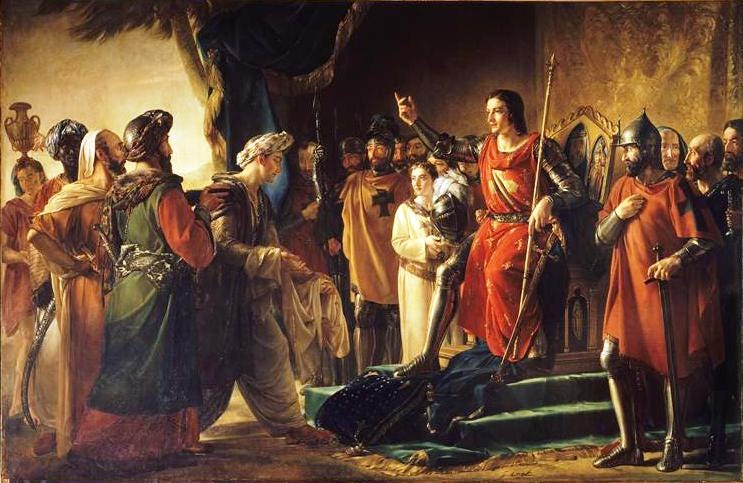
Greatness—it is a concept which flourishes in the minds of many still today, a call to glory and prowess which has echoed throughout history. There is no definitive manner in which to be dubbed the Great. It is a title bestowed upon certain men and rulers by various authors, often in posterity. Its meaning is well understood however, and its rarity demonstrates its magnitude and significance. It is perhaps the most honourable title a monarch can acquire, or so one would assume. Of course, such things depend on the values of those bestowing the title, and what they believe greatness means. Values shift with time.
Thus, in the Middle Ages, an era imbued with profound faith, in a time without continent-spanning empires such as Rome, in a period with scarcely any sweeping conquests, what did it mean to be granted the title the Great? Is it the same as in any other era, or are there unique factors to be considered?
Greatness across time
History demonstrates that greatness, and the title of the Great, has been bestowed for various reasons, but the predominant one remains military success. Plutarch, who analyses many such commanders in his work known as Lives, agrees with this principle, for not only do nearly all of his Greek biographies concern generals and conquerors, but it is the same with the Romans. First and foremost is the example of Alexander the Great (356-323 BC), who conquered the Achaemenid Empire and reached the Indus all before he was 33 years old. From Pyrrhus to Timoleon and Pelopidas, from Marcellus to Titus Flaminius and Paulus Æmylius, it is clear that those whom Plutarch considers important, or even great, are mostly military men, with a touch of lawmakers and philosophers such as Lycurgus and Solon. Thus, it is clear that greatness, in the ancient era, is given above all to the conquerors. But eras shift, and so too do their standards for greatness.
In what is often called Early Modern Europe, between the medieval era and the Industrial Revolution, the concept of military greatness returns once more, and this era also is full of greats including Catherine the Great of Russia (1729-1796) and Frederic the Great of Prussia (1712-1786). Both come with significant military successes. For example, though Empress Catherine’s reign is long and prosperous, one full of new cities and reforms, she is known for conquests through two Ottoman wars (1768-1774, 1787-1792), alongside the Partitions of Poland.
However, Empress Catherine is trumped by King Frederic, who, with a small militaristic state, managed to conquer Silesia and hold it in two brutal wars: the War of Austrian Succession (1740-1748), and then the Seven Years’ War (1756-1763). In the latter, he personally led his army to fend off the French, the Austrians, and the Russians under that same Empress. To stress the magnitude of this example, Prussia at the time had little more than two million people. France had approximately twenty million, Austria had ten, and Russia fourteen. Greatly outnumbered, Frederic triumphed in battle after battle. From one of many small German states, he forged a European power, one that would go on to dominate the political scene a century later and form the German Empire. He is indeed one of the greats, and clearly merits the title if it is to be attributed by military success.
Hence, eras before and after the Middle Ages argue for the Great as being a military title, at least among monarchs. One may believe these examples have been cherry-picked, for there are many who have attained far smaller military successes in these eras, and yet been dubbed great. But, when it comes to monarchs, these are quite few, especially outside the medieval era.
For instance, Constantin the Great, it may be said, did not conquer more than he unified, and so is not a great in the same way as Frederic or Alexander. Yet his success did depend on the Battle at the Milvian Bridge (312), and without it, Emperor Maxentius would have prevailed and most likely made of Constantine little more than a footnote, albeit a great footnote. Despite this, Constantine’s title as Great does foreshadow the defining factor of greatness in the medieval era, even if his depends on that military success.
Which monarch then, outside of the medieval era, may be called Great without military success? The examples are few, if even there are any. However, in the Middle Ages, the embodiment of Christian virtues became the highest possible achievement, thus expanding the title of the Great beyond mere military success.

The medieval aspiration
The medieval era is not the ancient nor premodern era. It is extremely vast, a thousand years, and full of shifts. Europe, much like the rest of the world, changes immensely between the commonly agreed upon dates of 476 and 1492. As such, greatness here too may change, and it must be determined whether military prowess is as important here as it is elsewhere, and what impact the unique values of medieval Christendom had on their conception of greatness. As the era is so vast, I shall take Charlemagne, otherwise known as Carolus Magnus, or Charles the Great (748-814), as a characteristic example of the early Middle Ages. As for the late Middle Ages, Stephen the Great (1457-1504) seems a perfect example of the twilight years of this fine era.
Charlemagne is a colossus who dominates the early Middle Ages like a cloud over the rest of his peers. Quickly, he goes from being one of two Frankish Kings, having split the realm with his brother Carloman, to the undisputed master of western Europe. Multiple times he smote the rebellious Saxons. He baptised their ruler Widukind (785). In the same vein, he marched into Al-Andalus, and made a march of Aragon, planting the seeds for the famed Song of Roland (778), first written around the year 1100. Alongside this, he reformed the Carolingian Empire through a veritable renaissance of art and culture, producing the script known as ‘Carolingian minuscule’ and important works such as those of the chronicler Einhard and his renowned Life of Charlemagne.
Thus the Emperor is not simply a great conqueror, but also a great statesman, and a brutally pious man, as shown in the massacre of Verden, where it is said 4500 Saxons were slain alongside their pagan holy site, the Irminsul. This adds a new dimension to greatness, for whilst in premodern Europe and in the ancient era faith is a less important factor, in the medieval era it is significant.
At the other end of the period, Stephen the Great, prince of the little realm known as Moldavia, is a unique and most fascinating monarch. In his approximately fifty year rule, he did not conquer the Ottomans, as Alexander did the Achaemenids, nor did he vanquish three superpowers at once, as did Frederic versus France, Austria, and Russia in the Seven Years War. Yet, Stephen the Great was an underdog and defeating an overpowering foe has always been a positive leitmotif. Undeniably, he was a military genius, having defeated the renowned Hungarian King Matthias Corvinus at Baia (1467), the Ottomans at Vaslui (1475), and the Poles at the Cosmin Forest (1497). Through all the troubles his little realm stood proud.
But here too there is the religious dimension present, as the greatest threat throughout his reign was the Ottoman one, which had reached heights unprecedented under Mehmed II with the conquest of Constantinople in 1453, putting a definitive end to the Roman Empire. The Ottomans brought tidings of Islam, and the contrast in faith and power heightened the stakes of the war and increased Stephen’s greatness by it, as is demonstrated in his obtaining of the title ‘Athleta Christi’ (Champion of Christ) through Pope Sixtus IV.
So it is that Stephen and Charlemagne became greats through both military and religious factors. But, whilst the military dimension is confirmed through victory, the religious dimension requires some other confirmation, notably papal confirmation, for it is the Pope who confirmed Charlemagne’s greatness by crowning him Emperor in 800, much like it is the Pope who confirmed Stephen’s greatness by according him the title of Champion. The Pope, as head of the church in an eminently pious era, takes on a considerable role in determining greatness within Christendom. Though he does not explicitly accord the title of the Great, his recognition of a ruler’s exemplary piety is certainly a helpful factor in attaining it.
This is unique to the medieval era. In the ancient era, the Pope is either non-existent or not as powerful. In post-medieval Europe, the Pope’s influence is terribly diminished by the Reformation. Yet even Fredric the Great was not known for spreading Protestantism in the 18th century. So it is only in the medieval era, at least in Europe, that greatness is so affected by religion and the title so dependent upon it.
Great v. Saintly
Yet there remains a certain question worth noting: what about saintly rulers? If a ruler is canonised, does that not also make him worthy of the Great by the standards of medieval virtue itself? Or must one fulfill both military and religious factors to be a medieval great?
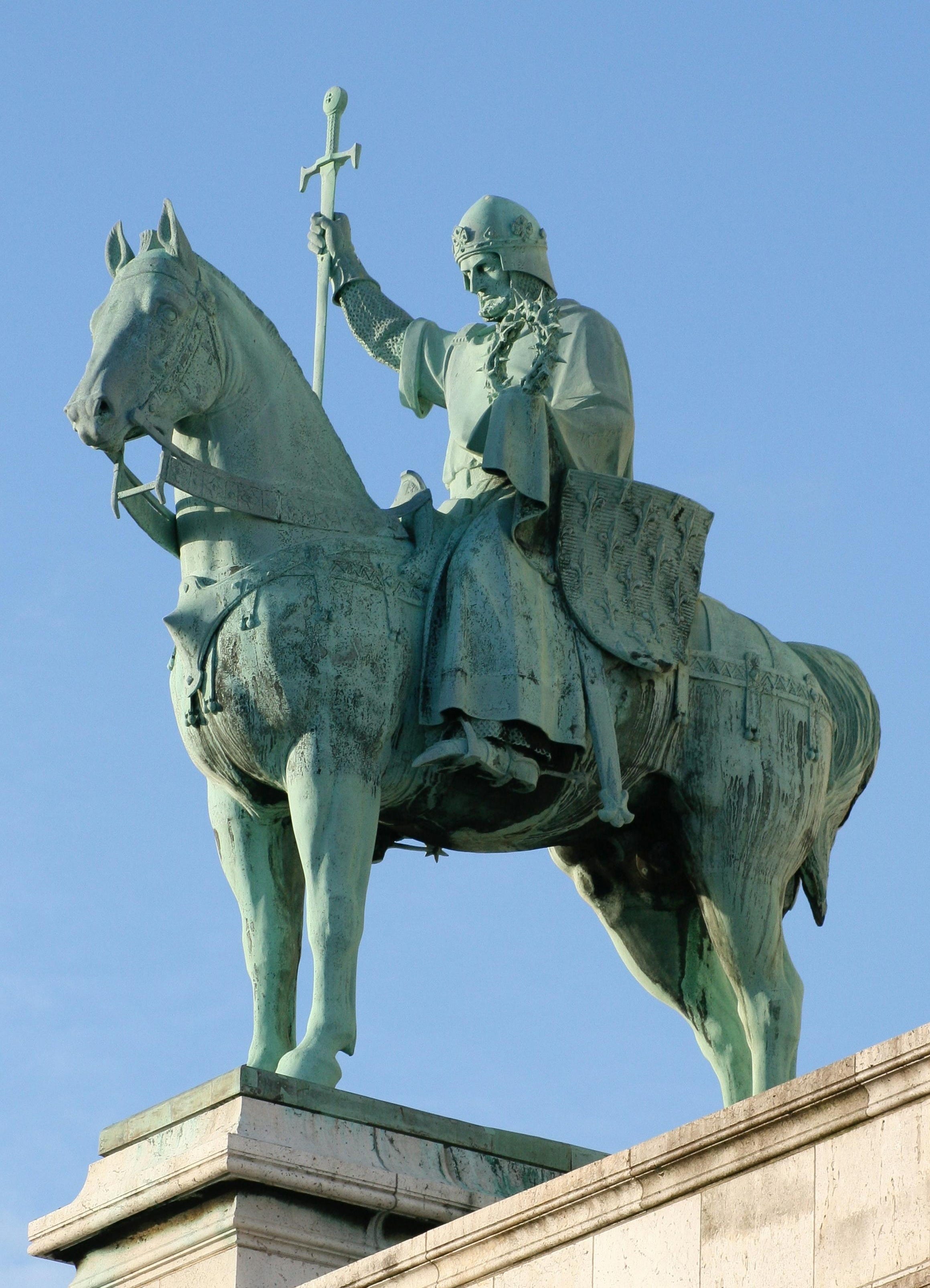
This is worth a little exploration, for in the pious era that was the medieval age, being a saint was certainly as great, if not greater, than being the Great. As a proud Frenchman, I shall happily admit to my bias and pick the example of Saint Louis, who despite being canonised is not titled the Great. Why? Surely, he was a great king. Canonised only twenty-seven years after his death, in 1297, his saintly status legitimised the Capetian Dynasty as a most pious and devout one, one of the few to include a saint. It solidified the Kingdom of France’s position as the ‘eldest daughter of the church’, and symbolised the long and particular relations it held with the Papacy.
Hence, one would assume he earned such status through an expansive and successful reign. He served justice fairly, under an oak tree, and even today is remembered fondly, with that oak tree becoming a symbol in France of a fair and just king, as depicted by the painting of Pierre Narcisse Guérin: Saint Louis rendering justice under the oak tree of Vincennes. This positive reputation is partially thanks to the wondrous chronicle of his life written by his seneschal Sir Jean de Joinville (a very good read with great action scenes). Perhaps, simply, had Joinville dubbed Louis IX as the Great in his writings, it would’ve stuck.
Or perhaps there is indeed something missing.
“If, on the sixth of June 1250, the French would’ve maneuvered as they had in 1798, they would’ve arrived at Mansourah by the twelfth of June: they would’ve found a dry Canal of Achmoun… they would’ve taken Cairo by the twenty-fifth… they would’ve conquered Lower-Egypt and its capital the very month they’d arrived.”
So does Napoleon himself speak of the Seventh Crusade’s failure in his memoirs of the Egyptian Campaign as presented by Thierry Lentz. Failure is one way to put it. Saint-Louis’ rule, militarily, is marred with failure. From 1248 to 1250, he embarked towards Egypt and spent two years battling across its desert plains, finally seizing Damietta. But there he tarried, the flaw Napoleon points to above, and was then captured at the Battle of Fariskur. Undeterred, ransom paid, he sailed to the Holy Land, salvaging the last vestiges of the Crusader States before returning to France in 1254. His failures haunt him however, for in 1270, recovering from a grave illness, he once more takes up the cross, journeys to Tunis, attempts to seize it, and succumbs to disease. So ends the Eight Crusade, a failure. So ends the life of a two-time crusader, having twice failed to defeat the Saracens and bargain for Jerusalem.

Sadly, even a Frenchman must admit, he does not fulfill the military criteria. He does not conquer as well as Charlemagne, nor does he triumph as doggedly as Stephen the Great. In that, he has been found lacking. His exertions and efforts in crusading and solidifying a foothold in the Holy Land are saintly, but they are not great, militarily, and he does not merit the title.
Piety over prestige
So where does that leave us? To be considered the Great as a monarch in the medieval era was an eminently militaristic and pious endeavour, requiring confirmation in both. The piety of it is what distinguishes this era from others. After the Reformation, it would flutter away, leaving once more conquest as the only criteria. Let us dive deeper however. In Joinville’s work on Saint Louis is this phrase:
“Master Robert, I would well enjoy having the reputation of preudhomme, if I truly am one, then the rest you may keep. For to be a preudhomme is such a great and good thing that merely pronouncing it fills me with joy.”
What is a preudhomme? In the thirteenth century, it is the chivalric ideal of all noblemen in the profession of arms. Hailing from the even older prodome, combining ‘prod’ (which then became ‘preux’, meaning valiant, galant, brave, or chivalrous) with ‘homme’, meaning man, it suggests one is a worthy knight, and therefore a worthy king in this case. Through this can we judge that being dubbed the Great was not what medieval rulers aspired to (”the rest you may keep”), at least not this one.
To illustrate this, further in the chronicle of Saint-Louis’ life is related a small incident wherein he attempts to return from the Holy Land to France, and on the way nearly dies in a shipwreck. Instead of proclaiming his survival as an example of his great destiny (or his lucky star, as Napoleon would have put it), Saint-Louis considers this an act of God to humble him, and remind him he is but a man before the divine. He interprets the shipwreck in a pious manner, a manner that would oppose being called the Great as too opulent and presumptuous a title for any man.
Further, there are many more great rulers than there are saintly rulers, which increases the value of it by its rarity. And, what was the worth of a conqueror in those days if he was not Christian and pious? In his Inferno, Dante did not place impious conquerors in heaven, and that is where a medieval king wished to be. Thus, piety trumps conquests, and saints trump conquerors; such are the medieval values. In a deeply religious society, being a saint is the greatest of honours, the rarest and most valuable. It is greater than great. Even without the title of the Great, greatness may be achieved through piety, according to the ideals of the time.
Indeed, the medieval era is special. The very way its rulers conceived greatness is starkly different to any other era due to the importance of faith. The conciliation of keeping the faith and shedding blood in battle has a name—one we all know—the very ideal Saint Louis reached when he was dubbed ‘Le Preudhomme.’ That is chivalry, which is true greatness in the Middle Ages.
Laszlo de Bellescize is a French-American writer who has been toiling hard on the medieval fantasy Speros universe since November 2023 in hopes of bringing heroic and knightly fantasy back. He’s self-published multiple books (The Scarlet Knight Part I and II) alongside medieval French short stories in various reviews. He loves history, and enjoys nothing more than a good historical discussion.
For further exploration:
Books:
de Joinville, Jean. Vie de Saint Louis. 1309. Classiques Jaunes edition, 2018. p. 367
Duc de Lévis-Mirepoix. La France Féodale: Tome VI. Librairie Jules Taillandier. p. 312
Plutarque. Vie des Hommes Illustres. Edition: Le Club Français du Livre,
Maraval, Pierre. Constantin le Grand. Texto, 2020.
Napoleon. Mémoires: La Campagne d’Egypte. Presented by Thierry Lentz. Texto, 2011. p. 204.
Videos:
Charlemagne (1/2): the Rise. Historymarche. August 7th 2021
Charlemagne (2/2): the Carolingian Renaissance. Historymarche. August 28th 2021
Stephen the Great vs. Mehmed II: Battle of Vaslui 1475 - Ottoman History. Kings and Generals. 11th of September 2025.
 | A guest post by
|